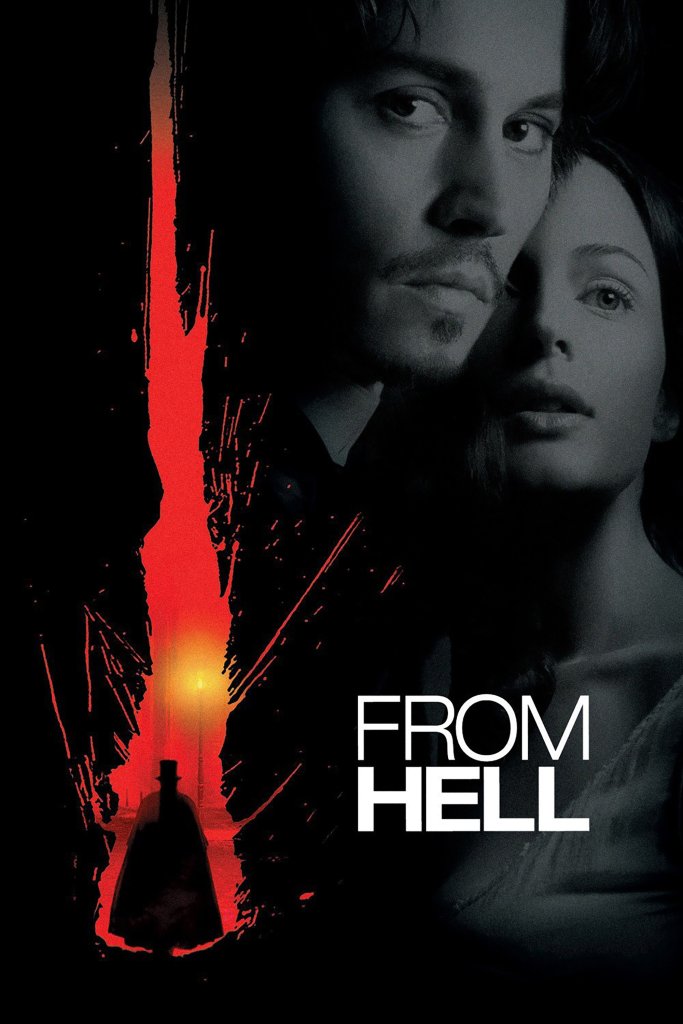
Remember how I said Stephen King didn’t like Kubrick’s adaptation of The Shining? Yeah, that’s mild compared to how Allan Moore feels about ALL of the movies based on his works. Given how often people have taken his ideas and characters and stripped all the meaning out of his graphic novels, I’m not surprised by his reaction, and From Hell is no exception, but it is a really good Jack The Ripper story.
This is probably the most beautiful serial killer movie I’ve ever watched, and I mean beautiful in the filthiest way. This film looks, sounds and feels exactly the way I imagine London’s East End did in 1888. It’s obvious how much time and care went into the costuming, set design and all the extras to make Whitechapel look like the densely populated slum it was. It all makes the city look alive and real, but do NOT mistake this tale for historical re-telling of the world most famous serial killer.
This is more of a Hollywood telling of a conspiracy theory than a serious attempt to portray the facts of the killings. A lot is omitted and many ‘facts’ are fabricated entirely. It’s a good story, and is entertaining, but it probably pissed off serious true crime aficionados almost as much as it did Moore. I’m not sure how I feel about that, personally. On the one hand, it’s a movie, it should be looked at purely as fiction, but when it’s told so well, you KNOW there is a significant percentage of the population that is going to believe everything in it is true, like so many people who’s beliefs about the Kennedy assassination were informed entirely by the Oliver Stone movie.
The acting is great. Johnny Depp, Heather Graham, Robbie Coltrane (I always love when he’s in a movie and will not watch anything HP related if he isn’t playing Hagrid), Ian Richardson, Sir Ian Holm (there are scenes were you can see the foreshadowing of a ring influenced Bilbo at the end), the cast is absolutely stacked and everyone does a great job, but Heather Graham is seriously mis-cast. Don’t get me wrong, she did a great job, and I think she’s a wonderful actress, she just didn’t fit the setting and the character. I know why they cast her, when they decided to fabricate a love story between Inspector Abberline and Mary Kelly, they needed an actor as beautiful as Johnny Depp to pair him with, it’s just that she doesn’t blend in with the other victims, or even the city itself. I’ll let the actual Brits comment on how convincing her and Depp’s accents are.
As a movie, I loved it. As someone deeply interested in the Ripper murders, there are more accurate tellings out there. I’m on a Johnny Depp kick, should I watch Sleepy Hollow next? Probably not, I don’t remember enjoying it. Maybe Sweeney Todd? Does a movie from 2007 fit within the time-frame of the challenge? Oh wait, I know the perfect movie…
If you’re not in the mood for movies and have a group of friends over, might I suggest some themed games appropriate for Halloween?
Zombies!
Judging by the number of Walking Dead spinoffs, zombies are still popular (George Romero’s daughter has a zombie movie coming out that I’m looking forward to) and board games are not immune to this.
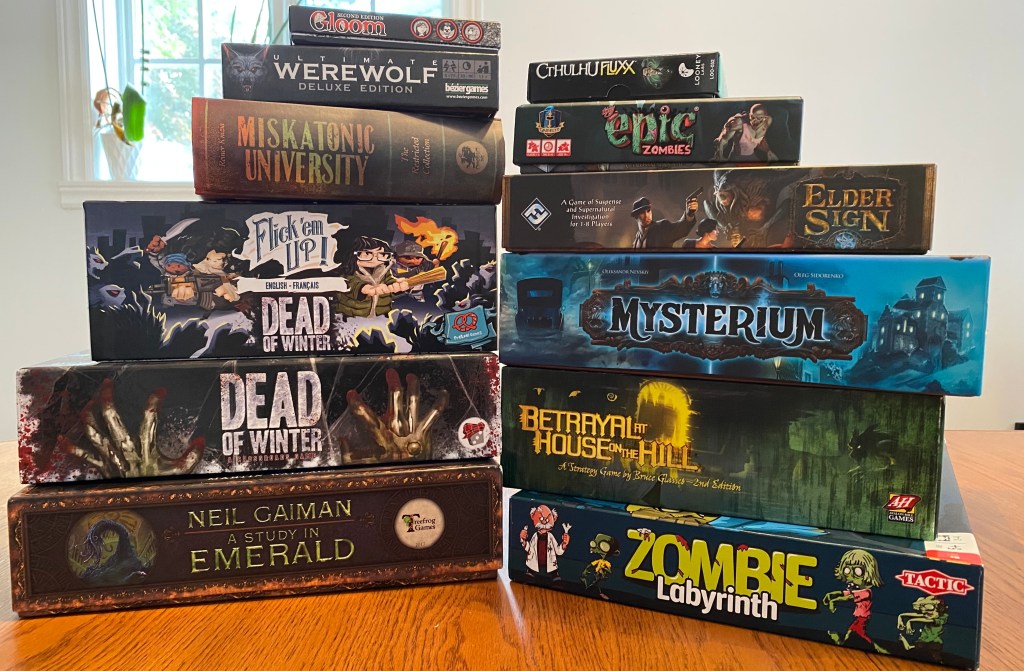
Dead of Winter – If you’re a fan of The Walking Dead then you’ll love Dead of Winter. It is a cooperative (maybe) game where the players take control of survivors in a zombie apocalypse. In addition to the main objective (which is chosen at random from a stack, so the game is different each time) each of the 2-5 players will be given a secret objective of their own. Some of the secret objectives may be in direct opposition to the main objective, making one or more of the players a secret traitor. The game makes use of Plaid Hat Games Crossroad mechanic, where a story card is drawn after each player’s turn, requiring them to make a choice with good or bad consequences. The random objectives, paranoia inducing hidden traitor and story driven Crossroad cards make this one of my favorite games.
Dead of Winter Flick ’em Up! – It’s Dead of Winter, but it swaps out the dice rolling for combat that has the players actually ‘flicking’ tokens at plastic zombies and barriers to knock them down. You still have random objectives chosen at the start, but no Crossroads cards. Also gone is the hidden traitor, instead the game can be played cooperatively or as teams of opposing factions. It is less story focused and is instead a physical dexterity game. Great for younger players, but keep away any pets that may want to eat a plastic token if it flies off the table.
Tiny Epic Zombies – It’s like Dead of Winter lite. Still a great game, slightly less story as there is no Crossroads system and no hidden traitor. It is faster paced than Dead of Winter and despite the smaller package and lower price-tag, it packs a lot of quality and value in the box, as most of the Tiny Epic line does. Unlike Dead of Winter, this game also has a solo mode if your (up to 5) friends are not available. It can be played cooperatively, free-for-all, or with a player controlling the zombies.
Zombie Labyrinth – Probably the most ‘traditional’ board game on this list, with the players rolling dice and moving tokens around a board. It’s not my favorite, but is great with younger players as the rating is for ages 5 and up.
Zombie Dice – Not pictured here because I can’t find my copy of it, Zombie Dice is super simple. You have a cup of coloured dice that have symbols for feet, brains and shotgun blasts. You are the zombies and you are trying to roll brains without getting blasted by the shotguns. It’s fast and easy to learn, but the rattling dice may drive anyone not playing crazy.
Gamers love Lovecraft
Elder Sign – One of the first games I bought when I started getting into modern board games and still one of my favorites. A museum in Arkham has accumulated so much weird stuff that the gates to beyond are starting to break. You and your team of investigators have to stop the weird and find enough Elder Signs to seal the breach and prevent one of the Ancients Ones from Lovecraft’s Cthulhu mythos from coming through. If you’ve ever played Yahtzee, you can play Elder Sign. You roll dice to match symbols to cards to earn rewards, using items you collect and your chosen investigator’s unique ability to manipulate the dice.
A Study in Emerald – Based on Neil Gaiman’s fanfic mashup of Lovecraft and Sherlock Holmes, A Study in Emerald is what happens if you LOSE at Elder Sign. Players are given secret identities at the start. Loyalists who are happy with the status quo and Restorationists are those who don’t want to live in a world that has been subjugated by a mad space god. We’d probably call those people ‘woke’ today. It’s a fun combination of worker placement and deck building with one of the oddest point systems I’ve ever played with. It’s almost impossible to tell who’s going to win until it’s all over.
Miskatonic University – Another quick and easy to learn game it’s essentially a card game with set collection that lasts only 5 rounds. Not as fun or thematic as the others on this list, but also not as complicated.
Cthulhu Fluxx – After Zombie Dice, this is probably the smallest and least expensive game in the list, but also one of the most fun. If you’ve never played a Fluxx game, the rules are simple. Draw a card. Play a card. At least that’s how it starts. As you play, both the rules and the win conditions change and keep changing. The Fluxx games are wild and unpredictable and that’s what makes them so fun to play.
Something different
Gloom – If you are a fan of The Addams Family, or Tim Burton’s new show Wednesday, then Gloom is for you. The objective of Gloom is to draw transparent cards from a deck and lay them on top of others to modify them and make your family of characters as miserable as possible, before bumping them off one by one to score points, or use the cards to improve the lives of your opponents. It’s a fun and funny 2-5 player game that is best enjoyed with friends who love telling stories about the tragedies that befall their family members
Ultimate Werewolf – The box says it is good with up to 75 players. It’s perfect for parties because there is no board, no game pieces, no dice to roll and you don’t need to be at a table to play it. Players are villagers, trying to figure out who is a werewolf before they get eaten, or werewolves trying to avoid suspicion so they can eat the villagers, the fun all depends on how into it the players get, and maybe how much alcohol they’ve consumed.
Betrayal at House on the Hill – I love this game so much. You are a group of friends exploring a haunted house, but you build the house as you play, tile by tile, so the layout is never the same twice. At one point in the game, a player will trigger “The Haunt”, which will reveal what is going on in the house, and turning one of the players into the villain. There are 50 scenarios in the book, combined with the randomness of the board creation giving Betrayal HUGE replay value. I have yet to play a game that wasn’t memorable. Just last week, I had people over to play, and the ‘Haunt’ player managed to kill himself the very first turn after the haunt was revealed, but he STILL won the game because our team was split up and our strongest character got lost in the basement (also, I was suffering from the Wil Wheaton curse of terrible dice rolling)
Mysterium – Everybody has played Clue at least once in their life, right? Now imagine one the players gets to be the ghost of the murder victim. That’s Mysterium. Up to 6 people take on the roles of psychic detectives while one player tries to direct them to the who, what, where of their murder, by sending visions in their dreams. It’s so much more fun than Clue.
That’s not all
There are more, many more, some I want but don’t have like Last Night on Earth where you play as survivors in a zombie apocalypse who are just trying to make it out alive, or Fury of Dracula, an asymmetric hunt game where one player is the titular vampire lord and the rest are hunters trying to track him down across Europe. It’s a fantastic game, but I don’t own it because my friend does.
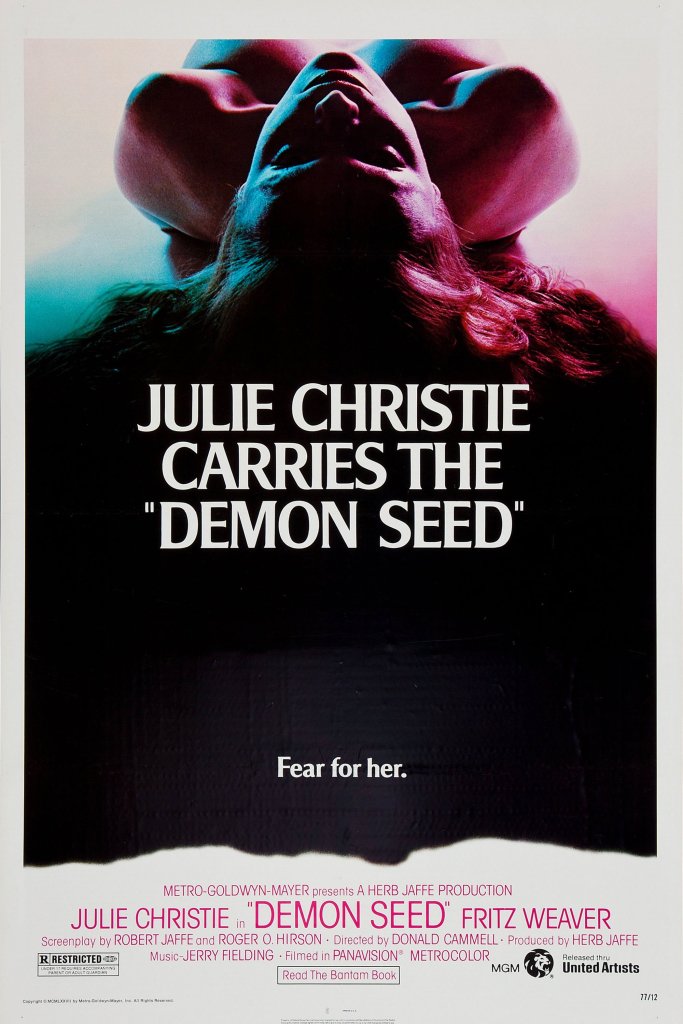
This movie is surprisingly ahead of it’s time. It’s about an AI that takes control of a smart home and kidnaps the woman who lives there, and it was made almost 50 years ago. Although, people back then obviously thought we’d be further along technologically than we actually are. This smart home was making drinks for people and opening doors, while I still can’t get Alexa to just remove the picture-in-picture on my Fire TV after my Blink doorbell rings (all three are Amazon products by the way).
At it’s heart, Demon Seed is a mad scientist/monster story a la Frankenstein, set in the budding computer age. I loved the initial robot body that Proteus builds for itself. It shows imagination on the part of the writers to not go the obvious humanoid route, and instead a collection of interconnected triangles that allowed it to re-configure it’s shape. TARS from Interstellar reminds me of it in a way.
The movie was well done and I enjoyed it, but I didn’t love it. I’m not sure why exactly, but I didn’t get as strong a feeling of menace from the AI as I should. Many of the scenes are disturbing, but… I don’t know. I can think of other films with computer villains that felt far more unsettling and creepy, like HAL from 2001 or GERTY from Moon. Maybe it was the lighting, the editing, pacing, the voice acting? Maybe all of it. It wasn’t bad, don’t get the wrong impression, I just felt, in comparison to other movies I’ve seen, it could have been stronger.
Demon Seed is currently streaming for free on Tubi in Canada, so you can check it out for yourself if you feel like it.
Before the re-watch, I remembered I liked this movie, but I had forgotten how unsatisfying the ending was.
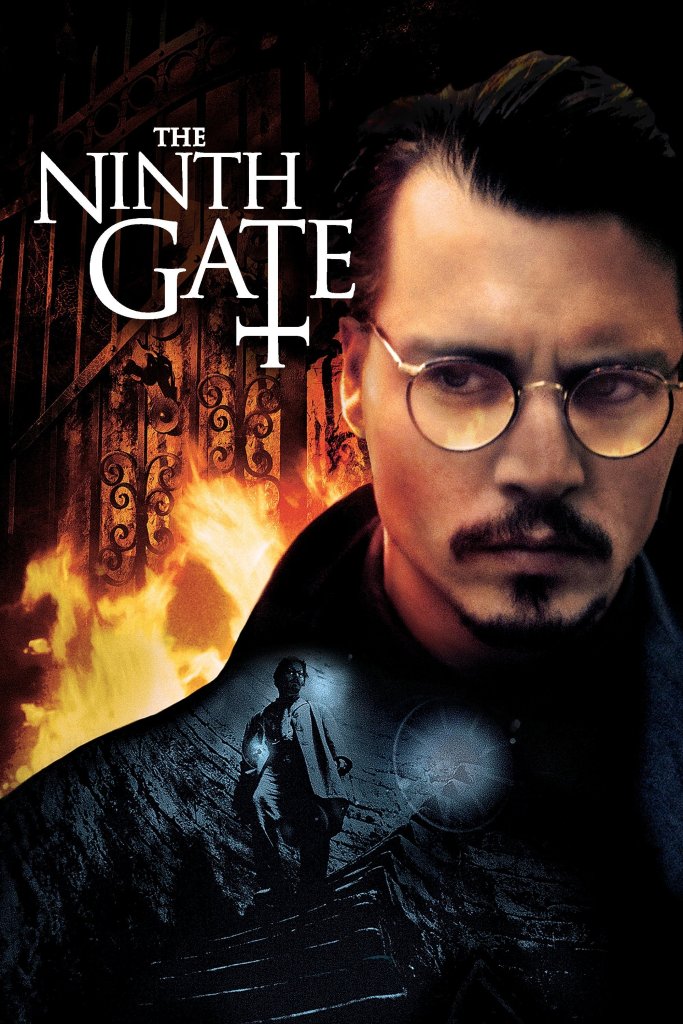
The film stars Johnny Depp as an amoral dealer in rare books. His character is kind of a dick and he plays it well. He’s hired by and even bigger dick (Frank Langella) to track down and compare two copies of a very rare book to his. The book is said to be able to summon the devil and Frank’s character thinks only one of the three is genuine.
The good. Johnny Depp, Frank Langella and Lena Olin. Great actors who do a fantastic job in this movie. I enjoyed that it plays out like a mystery and detective story all about books. I also liked the sense of dread and menace that runs through almost the entire film. From the moment Dean meets with Boris, the audience is made to feel suspicious, then anxious, nervous, paranoid, mimicking Johnny Depp’s character. The viewer never feels safe or relaxed. Even the lovemaking scenes are tense. You’re not aroused because you KNOW something is off about these women. It’s a masterfully told story.
The bad. Roman Polanski. I hate that such a terrible person still evades justice and continues to live his life free of consequences.
I’m also not a fan of the ending of the movie. Unless I missed a lot, it’s kind of ambiguous.
*Spoiler Time*
Who was The Girl? Was she a demon, an angel, Lucifer? Was the whole thing about leading Dean through the gate, Lucifer never wanted Boris in the first place? Were the Ceniza brothers part of the setup? Did the gate actually lead to hell? Was it SUPPOSED to be this confusing or did I miss signs while watching? Was this supposed to lead to a sequel? I don’t mind when a story doesn’t answer all our questions, or when the ambiguity leads to meaningful discussion among the viewers, but this was too many unanswered questions.
I’m kind of in the mood to watch From Hell now. Not sure if it fits this months theme or not.
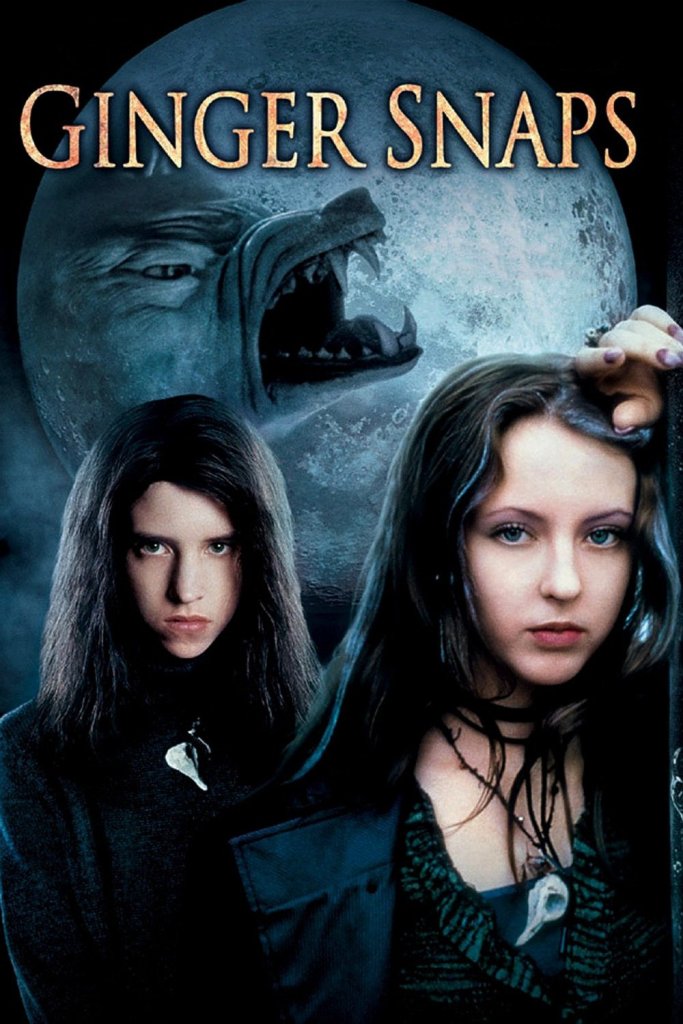
In 1985 I watched the Michael J. Fox comedy Teen Wolf. I loved it and did for a long time. Ginger Snaps is like the anti-Teen Wolf and it is soooo much better. Both are coming of age movies about outcast teens that become werewolves. Both have scenes with sports in them and both movies star Canadians, That’s pretty much where the similarities end.
This is another film that I had heard mentioned a lot over the years, but never watched. I could say I don’t know why I avoided it, but the truth is probably misogyny. At it’s core this is a story about high-school, teen girls and menstruation and I didn’t think I wanted to watch a movie about any of those things. I was wrong, and I wished I had watched this sooner.
My favorite thing about Ginger Snaps is the realism. No, I don’t believe werewolves are real and this is an accurate depiction of them, I mean it feels like the filmmakers started with the premise, “If my sister and I are out walking at night and are attacked by a strange animal, how would we react?” and everything flows from that. Their actions, reactions, the way they talk and behave are all natural and believable. That’s a big pet peeve of mine, when I think characters aren’t behaving like a reasonable person would, it pulls me right out of the story, so at the start of the film, I didn’t think I was going to like it, because I didn’t like Ginger and Brigitte.
Why are they so angry? Why are they so mean to their parents? Why do they hate life so much when they don’t seem to have anything to complain about? But that’s an old person’s instinctual response to teenagers. I see it a lot in people my age. We’ve forgotten how it FELT to be that age. What seems trivial and unimportant to us now in hindsight is the entire world to them. When I think back to how my kids were in their teens, how my grand-kids are now, the Fitzgerald sisters are 100% believable.
For a low budget film, it looks fantastic. Google says the average studio movie in 2001 cost $47.7 million, Ginger Snaps had only 4.5 to work with, which is $1.4 million LESS than the GOAT of werewolf movies was given in 1981. A lot of that I think can be attributed to director John Fawcett choosing to go far all practical makeup and effects. If they had used CGI it would have either eaten up a lot of the budget, or they would have had to settle for less or poorer quality. Going practical and keeping things dark worked very well.
I shouldn’t have slept on this film for so long, and I think it’s a lesson to be more open minded. The question arises though, do I watch the sequel? I haven’t had a lot of luck with sequels this month, especially with movies I really enjoyed.
The only thing I knew about this movie before watching it was that it was set at a ballet school, and I only knew that much from the promos released when the re-make came out in 2018. Unlike a lot of the other films I’ve watched this month, I’d never even seen the box for it at any of the video stores I’ve worked at.
Written and directed by Dario Argento, the look of Suspiria is unlike any horror movie I watched before. Most other films in this genre are dark and somber, but Suspiria is filled with bold vivid colours that dominate the scenes. The play of light and shadow is fantastic and does a lot to set the tone and mood. More so than the music, which I found too loud and confusing. It was filled with moans and wails and I often couldn’t tell if it was the music or something that was in the scene.
As gorgeous as the cinematography is, the visual effects don’t hold up as well. The blood is a bright cartoony red that no one could ever mistake for the real thing and there is a scene with a bat that looks exactly like the black tennis ball on a string that it probably was.
I still enjoyed it overall, and I find myself wondering if this may be a case where the remake actually improves on the original, but I may wait for next year’s marathon to check it out.
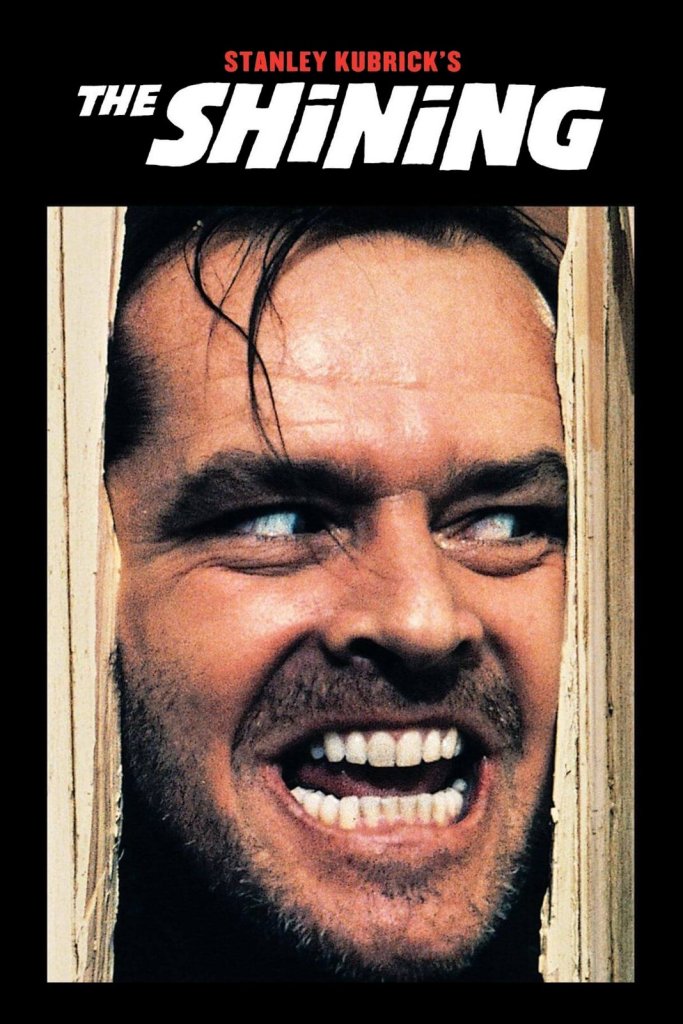
I mean… It’s The Shining. Not a lot for me to add that hasn’t already been said many times about this film. In the forty years since it’s release, there have been countless articles and interviews related to it, research papers, essays, probably a few doctoral thesis as well, not to mention all the books about Stanley Kubrick that have been published. As a lifelong Stephen King fan, and someone who started reading his books at an age modern parents would probably find shocking, I’m going to give my impressions about the movie from that angle.
When people compile lists of favorite horror movies, or even greatest films of all time, The Shining is always there, so it was fascinating to me that when I opened the Wiki page for this movie, I saw that that was not the case when it was first released. Reaction wasn’t just mixed, Kubrick and Duvall received nominations at the very first Golden Raspberry awards for this production. I think both were undeserved.
Remember back when I reviewed Sleepaway Camp 2 and I wrote how important music and sound was to the feel of a movie? This is the absolute perfect example of what I meant. From the very first scene when the movie opens, the musical score by Wendy Carlos and Rachel Elkind sets the tone. It is ominous and foreboding, despite the beautiful scenery of a mountain road winding through Montana (not Colorado as we are meant to believe) the audio cues fill us with a sense of dread, setting your expectations for the next two hours.
Google’s AI tells me there are over 77 books about Stanley Kubrick out there. AI lies a lot, but in this case, it’s probably not far from the truth, so if you want more in depth opinions on him as a person and as a filmmaker, you have plenty of options, but my opinion as someone who is going just by surface observations, is that if you take my complaints about the other 17 movies I’ve reviewed this month and fix them, you’ll wind up with a Kubrick film.
The soundscape, the imagery, the beautiful shots done with the newly available Steadicam, the natural dialogue and realistic character behaviours. It all just works. So why didn’t Stephen King like this version of his work? You’d have to ask him for the definitive answer, and I suspect as the years have passed, his stance has probably mellowed some, but I think it came from his inability differentiate between what works on paper and what works on screen. The thing I’ve always loved about King’s works is his ability to create characters you care deeply about. He then does horrible, horrible things to them which puts the reader through an emotional wringer. Part of what makes the people in his stories unique and endearing are the mannerisms and ways of speaking he creates for them (Laws yes!), but many times when you put them on screen, and have the words come out of a real humans mouth, they just sound odd and unnatural.
Books, because everything takes place in the imagination of the reader, also have the ability to compress or stretch time in a way we don’t notice while reading. This is very apparent in the 1991 TV mini-series version of this book that Stephen King himself wrote and produced. There is a scene where Danny is being chased by his father, they stop, have a conversation, and then the chase starts up again. That works in the pages of a book, but comes off as jarring and unrealistic when played out in real time for a viewer. Some things just don’t translate well from paper to film and some things need to be cut for time. As cool as the topiaries were in the book (they freaked me out and I’m sure were Steven Moffat’s inspiration for the Weeping Angels) they don’t add anything to the story or characters in an already 144 minute film.
One change the celebrated horror author and I both didn’t like *SPOILER ALERT* was the killing of Hallorann. In the book, he’s the one that rescues Danny and Wendy, he does too, indirectly, in the film, but they spend a good amount of time showing him being contacted by Danny, trying to reach Wendy by phone, calling the police, flying to Colorado, renting the Snow Cat, driving to the hotel, only to get killed as soon as he arrives? With no impact on the story except to deliver a car? The movie was already pretty long, it could have been trimmed and tightened if the getaway vehicle had simply been provided by a nameless sheriff’s deputy sent to check on the family when they became unreachable by radio. There was no need for Dick to die, unless Kubrick was trying to subvert our expectations, or simply for shock value after all the buildup of him coming to the rescue. I don’t know, but it’s the only thing I didn’t love about the movie.
Still a great film experience. Still holds up well, and a re-watch has put me in the mood to watch Doctor Sleep, the sequel I have never seen or read, but it’s not an old movie and doesn’t fit with this months challenge so I won’t be writing a review on it… yet.
For the longest time, I thought this was a Stephen King story. There’s just something about it that made me associate it with him. Probably the similarity between the “The Shop” and the company in Scanners that was producing a drug that gave people mental abilities. That’s not a spoiler by the way, it’s pretty much explained right at the beginning.
This movie is all David Cronenberg though, well, Cronenberg inspired by William S. Burroughs. It’s not as strange as Naked Lunch or eXistenZ and I’m not really sure why it’s considered a horror. The movie is more unsettling than it is scary, but it’s still really good.
It has been a long time since I‘ve watched Scanners and I had forgotten most of it, except the imagery of the people using their powers. I think that’s the thing about David Cronenberg’s movies, the vivid mental pictures that get burned into your memory and haunt you.
I’ve been a comic book nerd most of my life and this film is one of the few times I can recall mental telepathy being shown as an almost physical act, both the scanner and victims emote and struggle. It’s also not a passive thing, it’s an act they have to wilfully engage, which I guess is why two gunmen are able to get the drop on a literal room full of psychics.
Michael Ironside takes a lot of the credit for this movie staying with me for so long. His performance is fantastic. Actually, I’m trying to think of a movie with him in it that I didn’t enjoy and am coming up blank. There probably is one or two, nobody has a perfect track record of picking their projects, but I think it says a lot about the man’s talent and charisma that I only remember the good ones.
It’s not a perfect movie by any stretch, I feel Cronenberg is a lot like early William Gibson in not knowing how computers work and just making things up because it sounds good. I’ve worked in telecom for thirty years and I can guarantee, that even with psychic powers, there is no way a pay phone will explode like that unless you pack it with C4.
For an older movie, the effects hold up really well. The story has some pretty big holes if you start thinking about it, so it’s best not to get too analytical and just enjoy the ride.
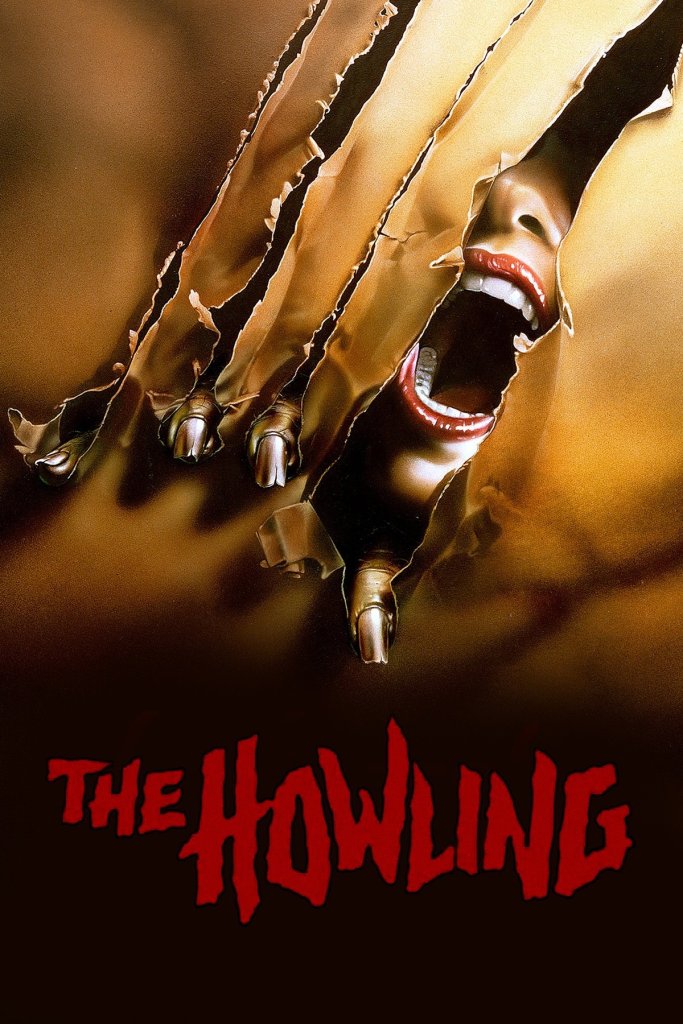
A product of the Roger Corman factory that produced incredibly successful directors, Joe Dante has made some of my most loved movies. Gremlins, Innerspace, Explorers and the underrated Tom Hanks masterpiece, The Burbs. Until now though, I had never watched The Howling.
I don’t think it’s giving away anything to say this is a werewolf film. I mean, the title is The Howling and just look at that poster. What’s cool about this movie is that it starts off making you think it’s about one thing, but transforms (like a werewolf, get it?) as it goes into being something else. Bottom line is I enjoyed The Howling, but I can’t discuss it more without spoiling things sooooo.
SPOILERS BELOW
Things I loved. Reporters. A lot of monster movies are about people in their teens and early twenties who inadvertently wind up victims of atrocities no one would ever believe. The main characters in The Howling are journalists who actively seek out the facts. That was a nice change.
I also like that it begins leading you to believe the story is about a werewolf serial killer, when it was more about a serial killer who just happens to be a werewolf, and part of a larger community of wolves.
My biggest complaint about the film is that I wish it had been longer, as I have a lot of questions that either weren’t answered, or maybe I just didn’t understand. The killer, for instance. How did the community feel about him? Was he an anomaly? Were they upset that he drew so much scrutiny down on them? His actions are never really discussed. You get a small glimpse that there is a schism developing between the traditionalists and “The Doctor’s” way of thinking, but it’s very brief and we aren’t shown much of their way of life. Why did the old man want to throw himself on the fire? Was he lamenting the loss of their traditional way of life? Was it dementia? Was he just a drunk who seeks attention by doing this all the time? Why did Patrick Macnee’s character bring Karen and Bill there in the first place? Was it to convert them, because they later plan to just kill Karen and make it look like an accident. I know that theatres didn’t like long movies back then, but I would have loved another thirty minutes to really flesh out the wolves and their story.
The special effects were good, but… An American Werewolf in London came out that same year and their werewolf transformation scene was mind blowing in comparison.
The ending was fantastic. I know I put a spoiler warning up already, but if you really haven’t seen the movie yet… no, you know what, I was going to tell you to stop reading and instead I’m just going to end the review. Go watch the movie.
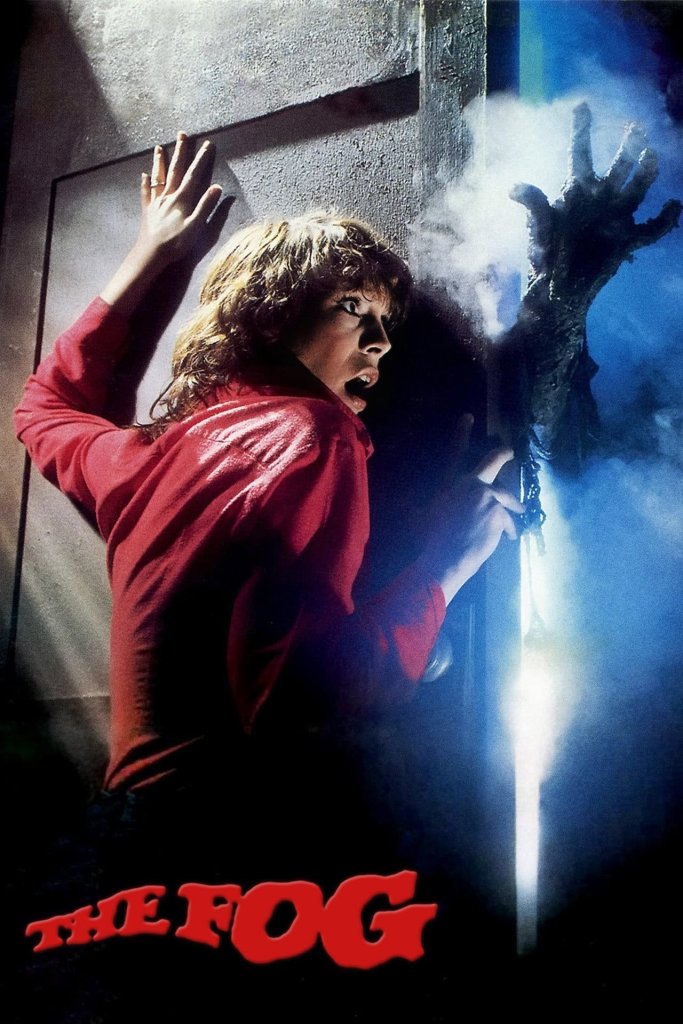
You can’t go wrong with a John Carpenter movie. Halloween, Christine, Escape From New York, Big Trouble in Little China, Dark Star (okay maybe not Dark Star), Prince of Darkness, They Live (campy but fun) and my personal favourite horror The Thing.
This one just didn’t click with me though, and I’m not sure why. There’s nothing I can put my finger on that really stands out. It’s a cool ghost story, which is a nice change from zombies, demons and vampires. It has a great cast, may be the first time I’ve ever seen Jamie Lee Curtis and her mother in the same movie, the dialog is natural and all the characters behaviour realistic. Maybe the cast was too big? It didn’t seem to have an anchor character and jumped around a lot. I assumed it would be Adrienne Barbeau, but she spent most of the film alone.
I think the issue this time was me. I was really tired and not in the mood to watch a movie, but did it anyway for the challenge. I think I’ll need to see this film again on a day I’m in a better mindset. Maybe I’ll do a John Carpenter marathon.
Despite the good rating on Rotten Tomatoes, The Fog doesn’t seem to be in high demand. I could only find it on Amazon and Apple TV.


 Late to the party, as usual